Have you ever looked at a text from someone you love and felt your stomach drop before you even read the words?
Your brain steps in fast. It tells you the message is nothing. It tells you that you are overreacting. You try to lay a logical explanation over a physical reaction, and for a little while, it works.
But your body already knows the truth.
You ignore that knot in your gut because naming it means facing something you would rather not see. We all do it. In the pursuit of love, we hand over our own warning systems again and again. We crave certainty, so we hold on to people who keep us guessing.
You are not broken for this. You are not weak. You are human.
But ignoring your body does not make the truth quieter. It makes it louder. The day you finally listen to your inner compass, love stops feeling like a game of survival. It becomes a steadier, more honest choice.
The Physical Difference Between Fear and Intuition
We ignore the inner compass most often because we mistake it for plain anxiety.
When you have been hurt before, your brain tries to protect you by sounding alarms at the smallest hint of trouble. That makes it genuinely hard to know whether your gut is warning you about a partner who is wrong for you, or whether old pain is simply flaring up again.
The fastest way to tell them apart is to drop out of your head and into your body.
How Fear Speaks
Fear is loud and panicked. It lives in a racing heart, a clenched jaw, and a desperate urge to fix the situation this second. It spins a frantic loop of worst-case stories and demands that you act before you have even caught your breath.
How Intuition Speaks
Intuition is the opposite. It’s quiet. It doesn’t shout. It arrives as a heavy, settled weight in your gut, or a strange, steady calm in your chest. It’s in no hurry.
There is real biology underneath this. According to a medically reviewed article from Harvard Health Publishing, the brain and the digestive tract are closely linked through the enteric nervous system, sometimes called the body's "second brain."
That connection is why emotional distress registers as real physical discomfort in your stomach. Your gut processes a sense of emotional safety before your conscious mind catches up. Your body is trying to protect you. You only have to learn how to listen to it again.
Why We Talk Ourselves Out of What We Know
If the body is this wise, why don't we always listen? Usually, because of hope. We see the potential in a partner. We remember how attentive they were in the first month. So when their behavior shifts and your gut says something is off, hope rushes in to argue.
Accepting that truth means facing disappointment, maybe even a breakup. So you start lining up excuses. They are just stressed at work. You are asking for too much. Maybe if you change, they will go back to who they were.
This is the real reason you end up so drained. It takes enormous energy to keep talking yourself out of what you already know.
Why Asking Your Friends for Advice Keeps You Stuck
When that heavy feeling lands in your stomach, what is the first thing you reach for?
If you are like most of us, it’s your phone. You text a confusing message. You send it to your best friend, your sister, or the group chat. You ask the same question every time: "Am I crazy, or is this off?"
You are not crazy, and you are not weak for wanting reassurance. But notice what you’re really asking for. You are hoping someone will talk you out of your own truth.
When you collect five opinions, you crowd out your inner compass. You trade your physical knowing for other people's logical guesses. Your friends love you, but they are not living inside your body. They cannot feel the tightness in your shoulders or the shallowness of your breath. Only you can.
Recognizing the Signs of Misalignment in a Relationship
Trusting yourself means learning to read the physical signs of relationship anxiety as they show up in your body.
Love should not feel like a standing emergency. It should not require you to shrink yourself to keep the peace.
Here’s a simple way to decode what your body is telling you. Notice how alignment and misalignment actually feel, moment to moment.
| The Physical Reality | When You Are in Alignment | When You Are in Misalignment |
|---|---|---|
| Breathing | Breath is slow, deep, and steady. | Breath is shallow and trapped in the chest. |
| Muscle Tension | Shoulders drop. Hands are open and relaxed. | Jaw clenches. Shoulders are tight and raised. |
| Communication | You speak plainly. Silence feels perfectly safe. | You over-explain. Silence feels like a threat. |
| After Interactions | You feel grounded, energized, and clear. | You feel exhausted, confused, and heavy. |
Rebuilding Trust With Your Own Body
If you’ve spent years overriding your gut, you won’t repair that overnight.
Rebuilding self-trust is a slow, steady practice, and it starts in small moments. You’re teaching your brain to stop steamrolling your physical reactions.
A Simple Practice
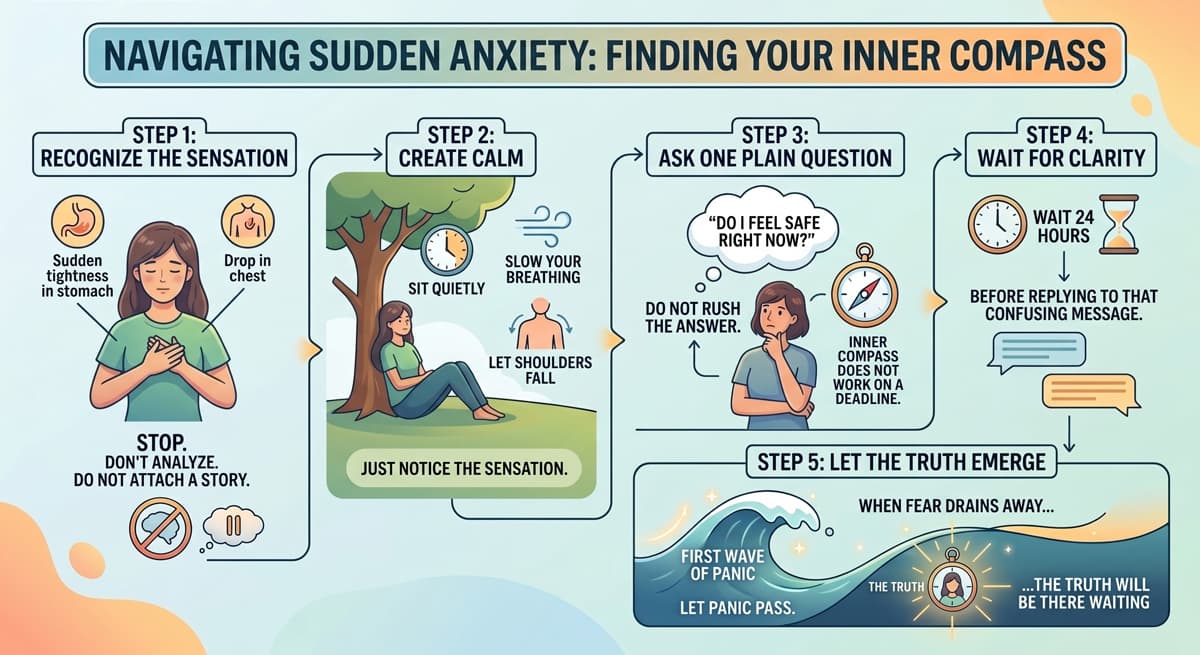
The next time you feel that sudden tightness in your stomach or that drop in your chest, stop. Do not analyze it. Do not attach a story to it. Just sit somewhere quiet and notice the sensation.
Slow your breathing. Let your shoulders fall away from your ears. Then ask yourself one plain question: "Do I feel safe right now?"
And do not rush the answer. Your inner compass does not work on a deadline. Give yourself twenty-four hours before you reply to that confusing message. Let the first wave of panic pass. When the fear drains away, the truth will still be there, waiting for you to look at it.
Navigating Anxiety
Click to enlarge.
The Quiet Strength of Honoring Your Truth
You already hold the answers you are looking for. Trusting yourself in love will not keep you from ever getting hurt. It will not make every relationship simple. What it will do is end the habit of abandoning yourself to keep someone else around.
When you stop treating your gut feeling as an inconvenience, the whole shape of your love life changes. You stop asking, "Why are they doing this to me?" and start asking, "Is this right for me?"
You are the one in control. Let your shoulders drop. Take a slow breath. You are safe, and you already know what you need to do.